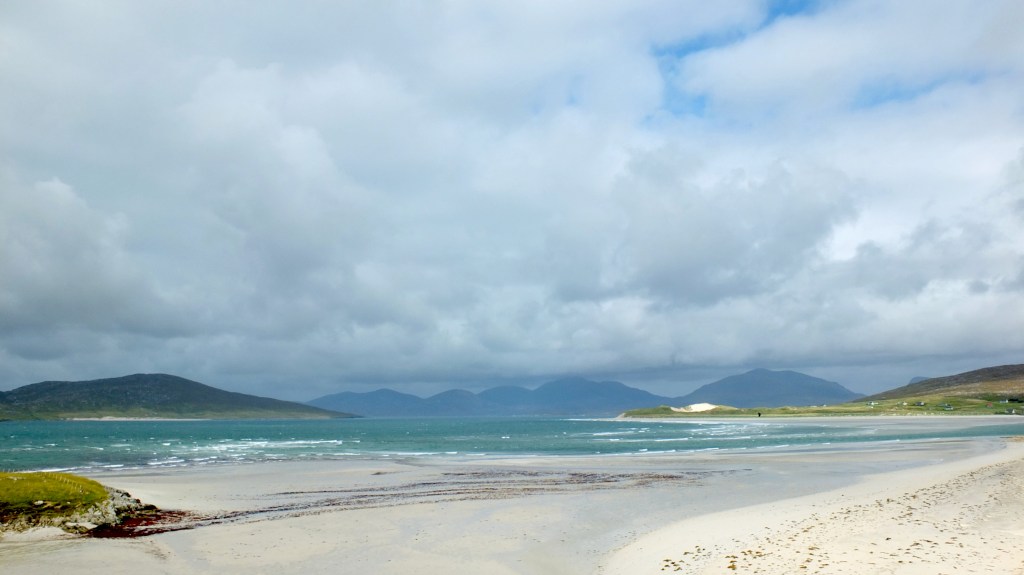
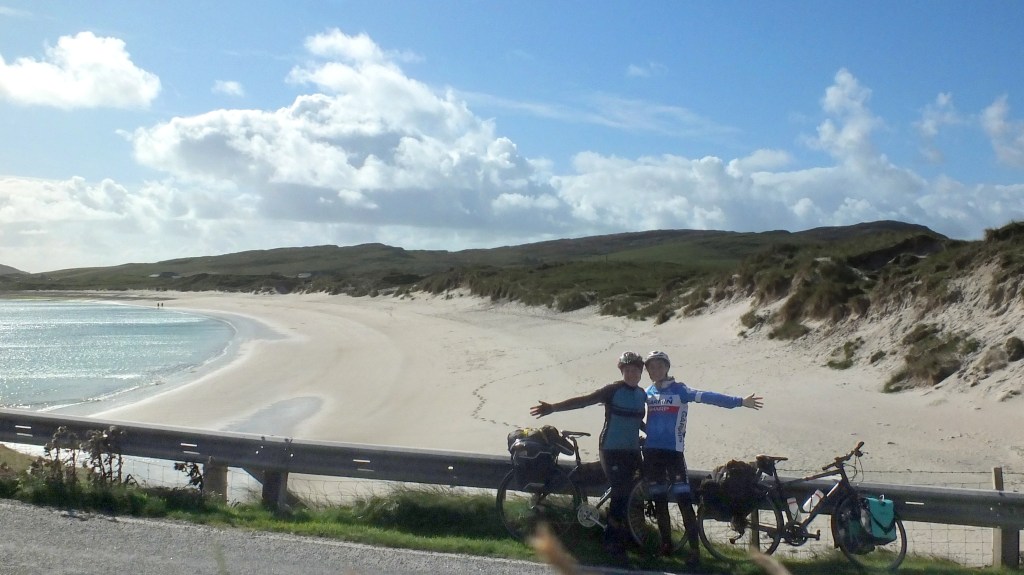
The tales and travails of another long distance ride shall be described here. This one was a very different pace to the very-long-and-exhausting Land’s End to John O’Groats ride of the previous several writings. Rather than race over as much distance as possible, my wonderful friend Kate and I decided that we’d much rather lean on the ‘touring’ part of cycle touring. We both love the scenery of Scotland, we both enjoy a bit of flying-by-wheels, both love a little creative project (writing for me, photography for Kate), but neither of us had cycled with our homes and larders strapped to the bikes before. So, off we headed to do a nice gentle tour of the Outer Hebrides.
We hauled our bikes on the train to Oban, hauled them off and on to the ferry to Castlebay to begin our tour from the southerly islands. That ferry journey in itself deserves some mention first though. Rather naively, I had not worked out that a five hour ferry journey westwards from the edge of Scotland would mean travelling across the Open Atlantic. I thought it would be five hours of a little chuggy ferry boat, thinking very much of the little chuggy ferry boats I know from Falmouth. It was not a chuggy little ferry boat. Lorries could fit on this thing. Lorries. In plural. We flock of cyclists wove our way through the vehicles to rope our bikes to the walls. Kate and I then settled down for a lovely ride at the top-front of the ship where the windows were big and low, and the views long and wide. The first two hours of sheltered journey were highly pleasant. We saw a rainbow colouring the way to a bright white house on an isolated island. We saw dolphins in the sea below. We saw islands fading out in the distance and layers of weather folding in and out of the hills. We enjoyed them all lounging on long sofa things. But this was not a wise location to have chosen. Those two pleasant hours were followed by two hours of the worst ferry journey I have ever experienced. The tail end of hurricane Dorian could and did reach us all the way in these remote seas of Scotland. The first I knew of the swell was when my stomach was left in the air above my head on our first roaring descent. We saw the horizon disappear then reappear then flood everything then float below us again, and again, and again, for two solid hours. The ship boomed every time we landed back on the sea. Before long, I was too queasy to even contemplate moving from our settled spot. Should’ve recognised the washes of heat and sheen of sweat and rapid heartbeat for symptoms of what they were. The only option left was to lie down in that same settled spot and pretend it was a dream. A nice, rhythmically rocking dream. It worked very well. The last hour was bearable. From now on I shall lie down from the start and dream it away. The people opposite us were unaffected and were happily drinking cider for the whole journey. I cannot think how.
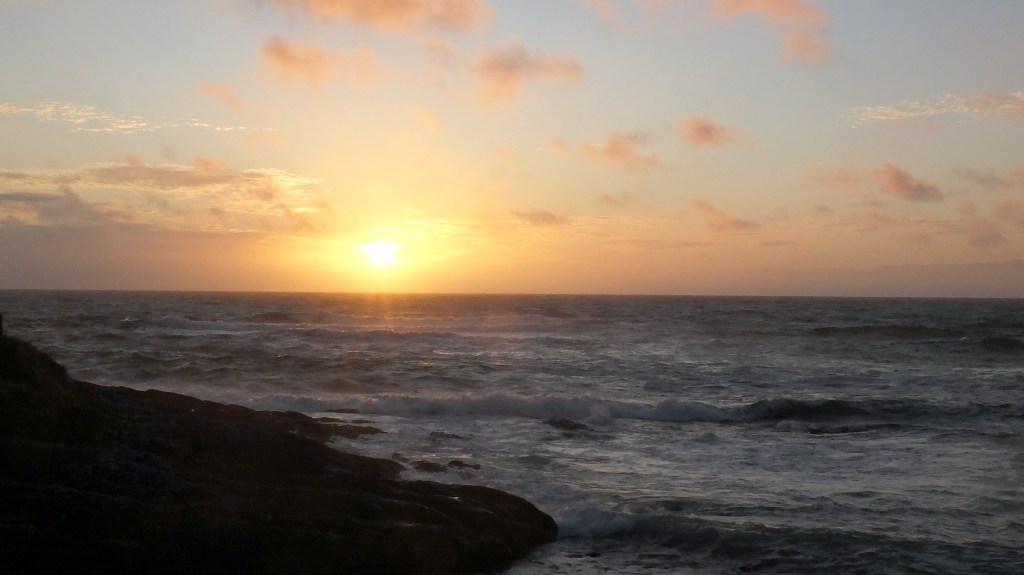
Campsite number one, when we finally reached it, was perched on a narrow shelf of grass on the ocean-side of Barra island. The waves were quite magnificent to behold. I learned on that day that I love the sea from the coast, and only from the coast.
Cycling day number one opened with clear skies, bright blue seas, and a nippy breeze. We wrapped up warm, wrapped up the bags and bikes, left the memory of the ferry behind, and rode back the way we came to reach the white beach of Vatersay island.
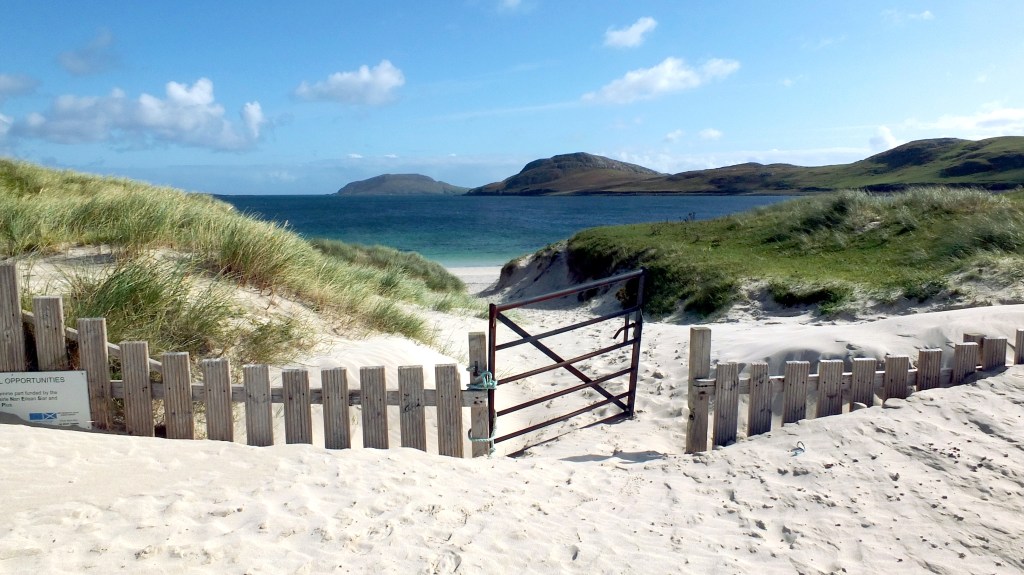
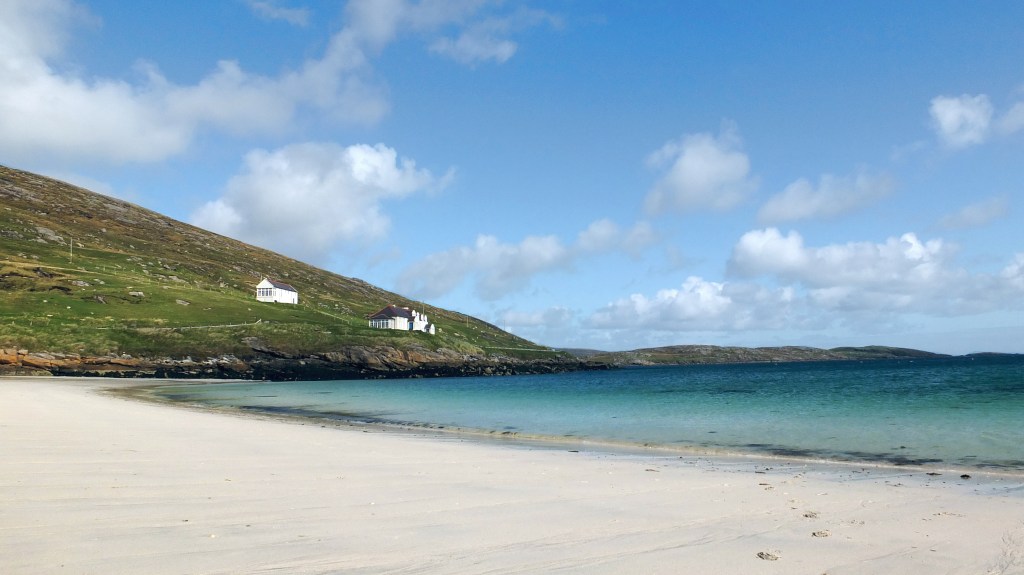
And so our cycle journey truly began from our southerly point on Vatersay beach. With it also began my stream of comparisons with Cornwall. Vatersay beach, with its luminous, smiling white sands and delightful, gentle sea struck me heavily as being very much like beaches around the Isles of Scilly. I was sat on a similar beach last September with two other friends and a crochet project, getting fine white sand brushed into my wool. And the year before, exploring another beach on the Scillies in the dark with one of those same friends. Moonlight lit our way and we saw no one but the stars and were bothered by nothing except the weird sand-shrimp creatures that sprung up around our food. Both times glow in my mind of the last vestiges of summer before very long, very difficult, very tiring winters. Last winter was PhD write-up and I barely saw the bright light of day. Finding Vatersay beach evoked those memories from the furls of my mind so strongly that they flavoured the rest of our cycle. We’d see some Rhodedendron plants somewhere along the Hebrides and I’d shout,
‘Look! Rhodedendrons!! Them’s like in Cornwall!!’
Kate would nod and say, ‘Yes Alice, we also have them in Scotland.’
And then I’d see some brown seaweed left behind by the tide, and shout,
‘Look!! We have seaweed like that in Cornwall too!!’
Kate would roll her eyes and pat me on the head.
My hysteria was near tangible when we spotted some Rhodedendron and gunnera plants in the same ditch.
‘Looook!!!’ I said, stomping my feet in excitement. ‘It’s just like Cornwall!!’
‘Mm-hm.’
‘And those pine trees!! Those are all over Cornwall! Don’t they look wonderful silhouetted with the sky behind!’
To which Kate replied, ‘Those are Scots pines. From Scotland. Mightn’t Cornwall be like Scotland rather than Scotland like Cornwall, do you think?
‘Hmpf’, said I.
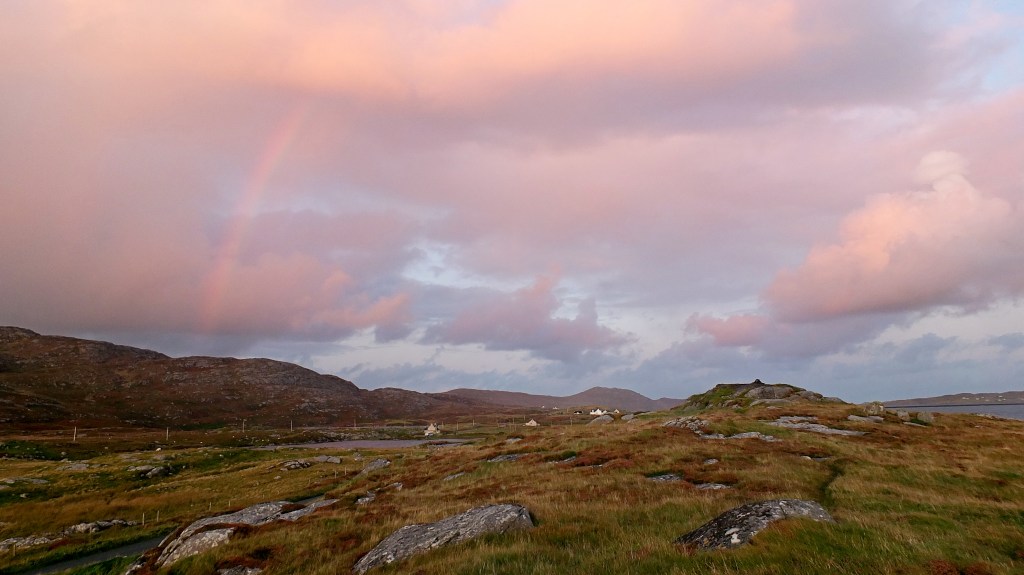
As for the rest of the Hebrides, they are the Scillies but larger, colder, more imposing. More Scottish? Both are a collection of islands further away from the mainland than I thought they would be. Nothing is visible from the horizon beyond the next island except sea breaking through sky. Both were found and occupied, somehow, by ancient peoples who thrived and left magnificent stone monuments of their lives spent there. Both have that small-island feeling of trust and closeness, where everybody knows exactly who the visitors are. Both have the whole world in a teacup, with the end of the island just over there and everything to live by in between. But both are removed from the whole world in ways it is difficult for a mainlander to imagine. World news might as well describe the hypothetical events of the distant future or past. On the Hebrides, Kate and I listened to a radio station narrated entirely in Gaelic and understood not a word. The pace of life is different. The aims and ambitions of life there are different. Finding a shop between all the fields and sheep and isolated homesteads and churches for some milk is difficult. The ways to offend people are different. Sundays are sacrosanct and shall not see laundry hung outside.
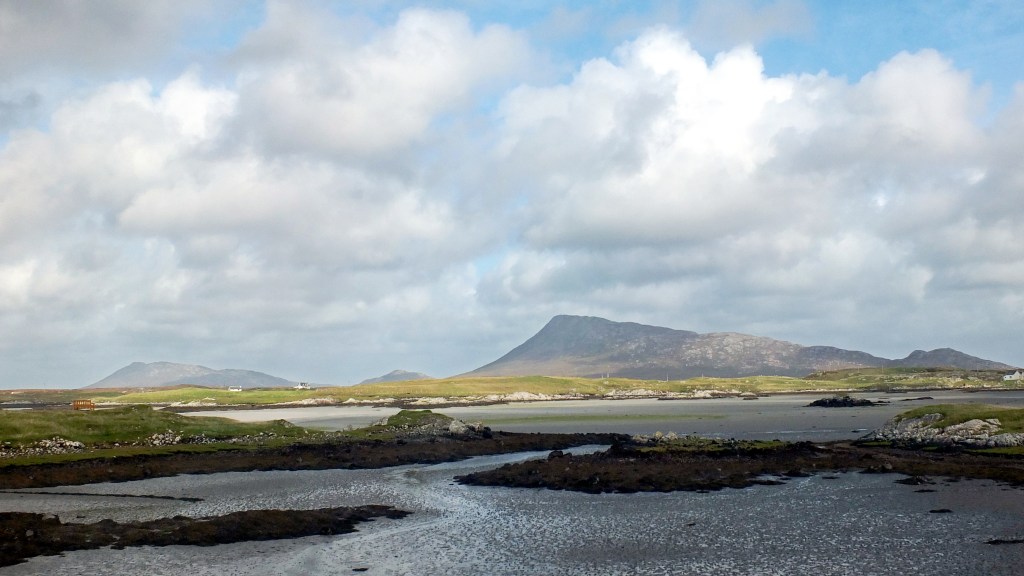
Onwards we cycled, up through Barra and Eriskay, on to South Uist, Benbecula, and North Uist. These islands were some of our favourite because there was a little of everything. A little mountains, and little sea, a little ferry journey, and little road elevation, a little dash of light green smothered by mist, a little museum (with BIG cake), a little headwind, a bigger little tailwind, and a little wave from the vehicles passing by.
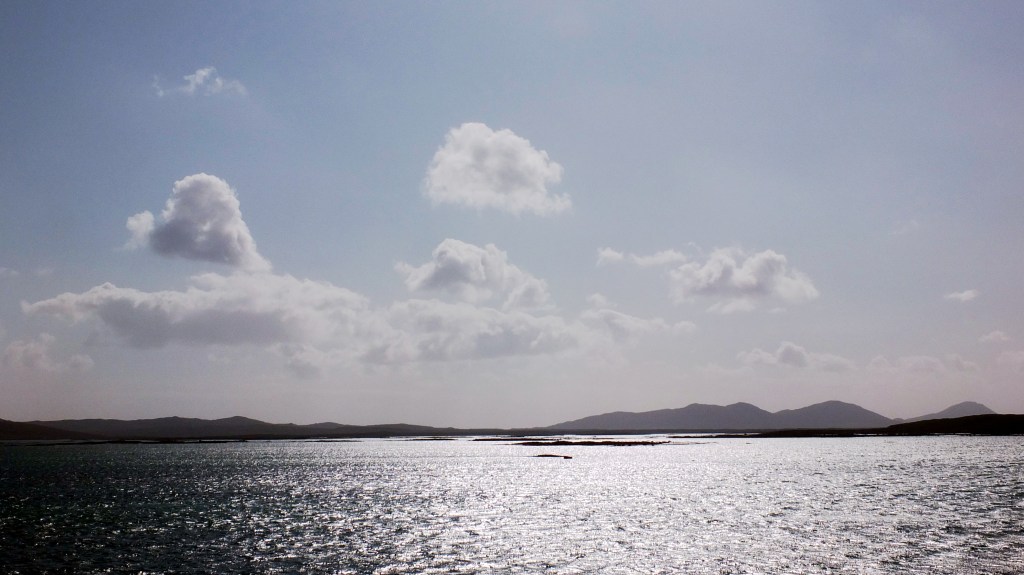
A little annoying though, was the insistence from my little cycling map device that we should turn around now to find the road parallel to our current one and cycle there instead. So, dear reader, we were on single-track roads for the majority of this bike ride. A junction would offer the choice of going left or right around the island, or straight over if we were lucky. The mere thought of their being a choice of roads to take us in the same direction would have been amusing if we couldn’t already clearly see fields stretching out on either side to meet… not another road. But the map device insisted with many little bleeps that we were wrong, and still wrong, and still wrong, and why aren’t we turning around already?!
Before leaving Edinburgh I found a little book on the Callanish Standing Stones to read as we were going along. In this little book is a description of the work of Martin Martin:
“Some twenty years later [after 1680], Martin Martin produced the first plan of the site [Callanish]. It was extremely inaccurate, with far too many stones in the avenue and only three in each of the other rows. His plan did not even match his written description, which gave four stones in each of the S, E and W rows.”
[Gerald Ponting, 2007, Callanish & other megalithic sites of the Outer Hebrides, p10]
After reading that, the map device was named Martin Martin.
BLEEP! Martin Martin thinks we should have turned left there. BLEEP! Martin Martin thinks we should be at the campsite by now (a good hour or two ahead of our actual schedule, because Martin Martin doesn’t understand ‘bike touring’). BLEEP! Martin Martin just wanted attention. BLEEP says I, when Martin Martin displays the map upside-down or sideways again because we aren’t pointing north.
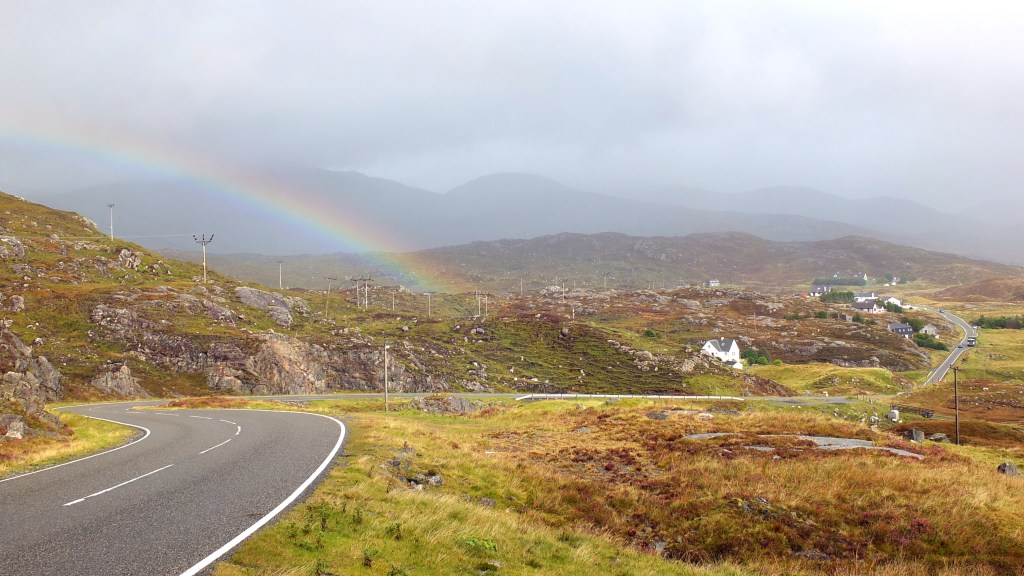
With Martin Martin (and the back-up paper map) Kate and I did find our way. Some of the most spectacular roads were the causeways built between these islands. Cycling on water did indeed feel real along there! As did the headwind, with absolutely no cover from any direction to shelter us along our way.
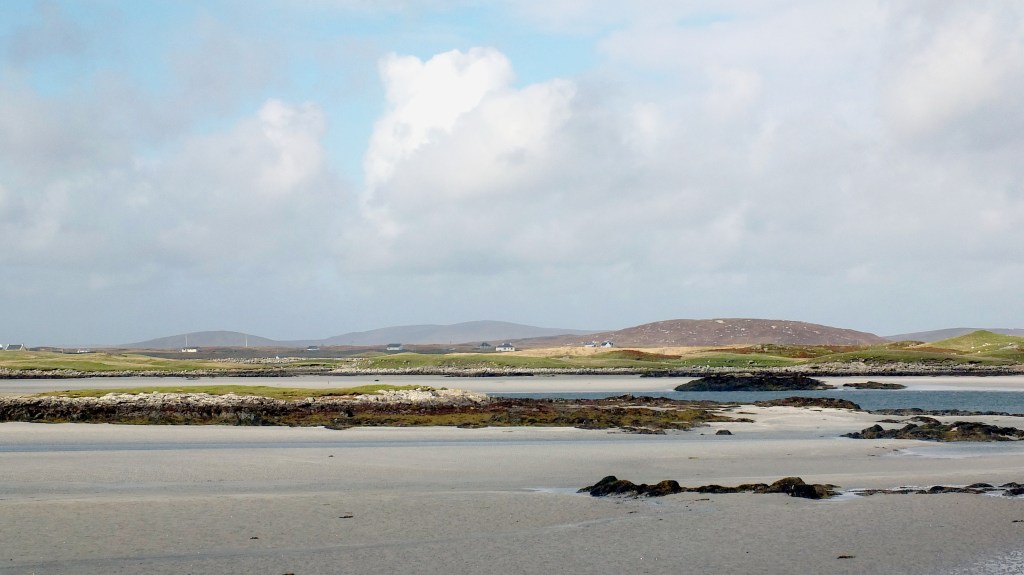
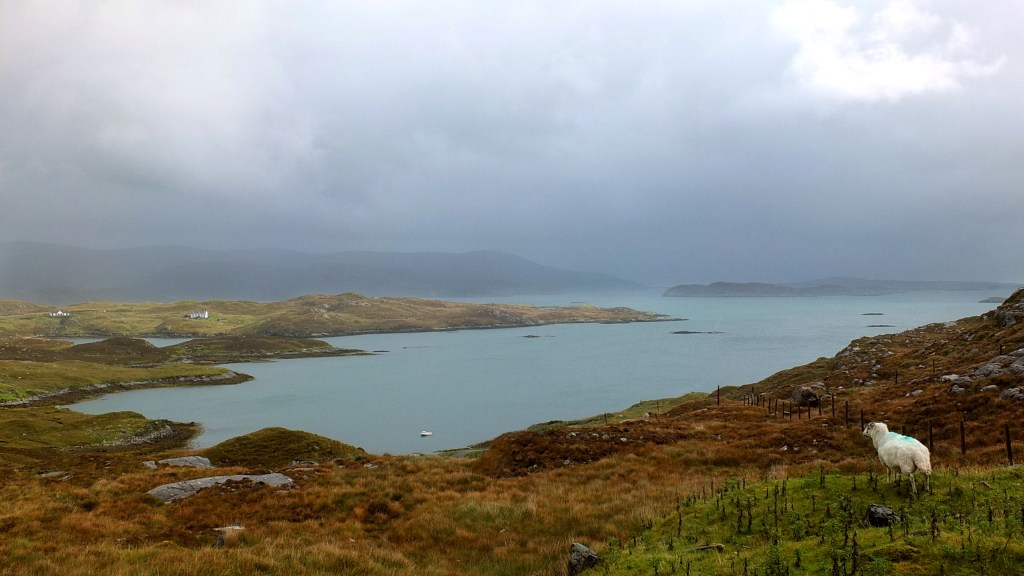
One aspect of the Hebrides was very different to Cornwall: the colour palette. This was all the more apparent when we were crossing between islands and could see the full range of landscape before us. Cornwall is rich gold and deep turquoise and bright blue from the sand and sea and sunshine. Cornwall is outlined by shadowy relief from the sun from around cliffs and stone hedges and Scottish-Cornish pine trees. Cornwall is heavy, dense to breathe in, depressing in missle. The southern isles of the Outer Hebrides are very different. Replace those deep, bright colours with soft green, shades of grey, and fading blue. Daylight softly clouds around any edges to illuminate everything in a pale glow. Sharp breezes pinch at your skin and whisk away your breath before you were quite done with it.
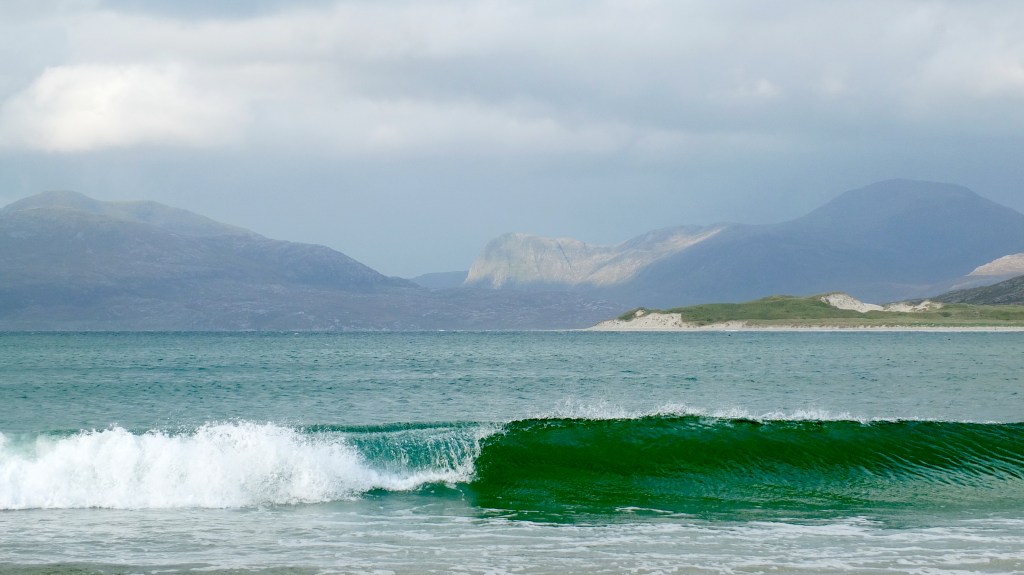
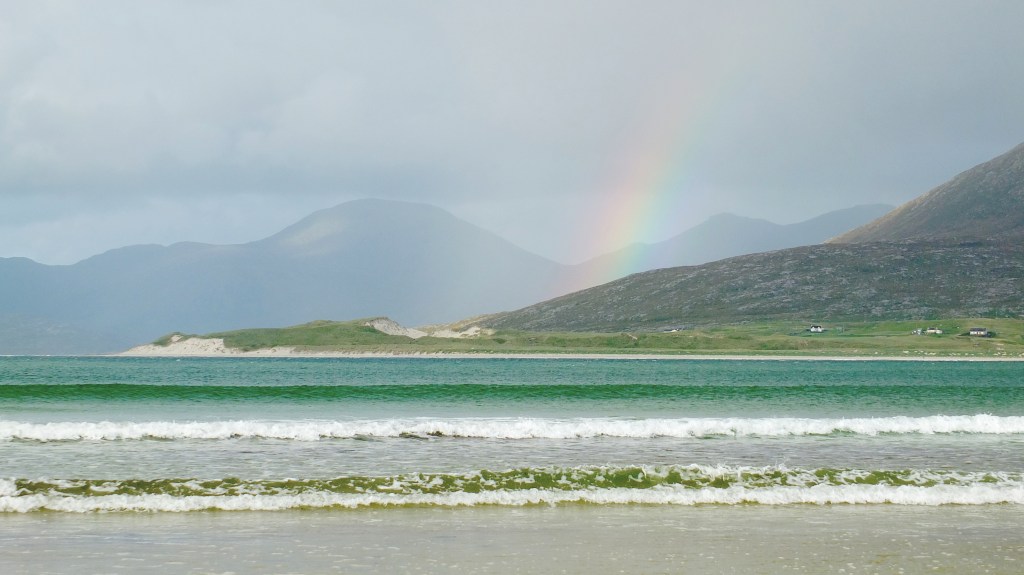
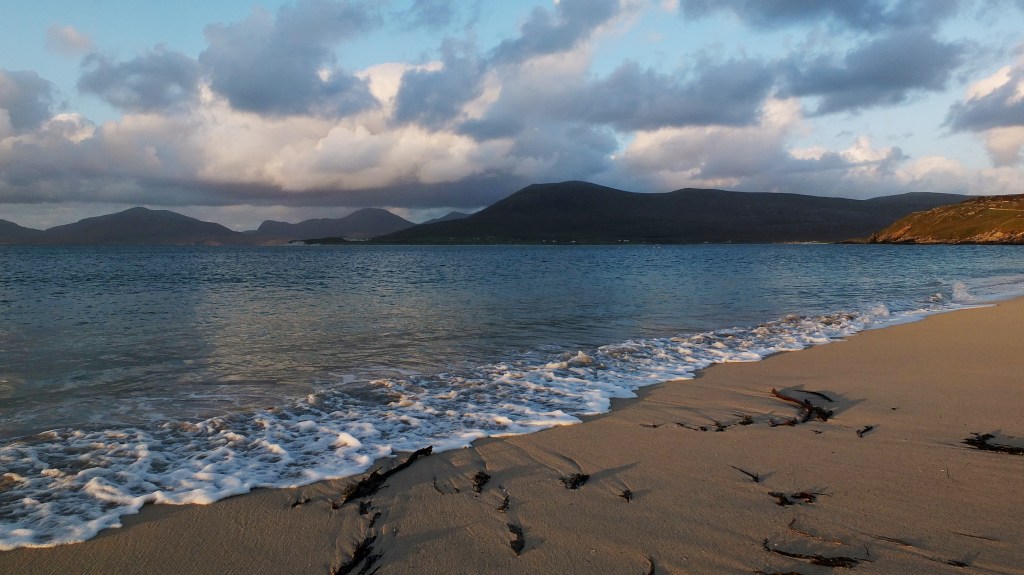
Onwards from North Uist, we reached the Isle of Harris. Our chosen sleeping spot was at Horgabost where we found a beach that filled a hole in my life I did not know was there. In that little corner of the world, a pool of the Atlantic sea stretches itself over a lonely expanse to hug bare, mountainous faces on all sides. Never have I been somewhere that felt so huge, so terrifying, but so close and so friendly in the same bundle of thought. Our view from the beach belied how very distant those mountains were from one another. They could be whispering together, just out of earshot. The silence of the mountains and waves crashing up them is unnerving for a little person sat in the sand a very long way away. Time is visible here. Not the hustle and bustle of a lived lifetime, but the slow, inexorable, thrumming silence of time passing by in the ground sleeping beneath our feet. The time it takes to build mountains and to fill oceans. The time it takes to grind rocks into sand, for waves to travel across the water and for sound to be lost across the sea. The time it takes for suns to set and stars to form. It is humbling to remember that our time now is but a fleeting flicker of a moment. Perhaps for this reason, over all others, I became an archaeologist. Our fleeting flickers of moments can leave traces behind which light up once again under the gaze of an archaeologist, flickering in their own fleeting moment of time. We extinguish quickly, but not entirely.
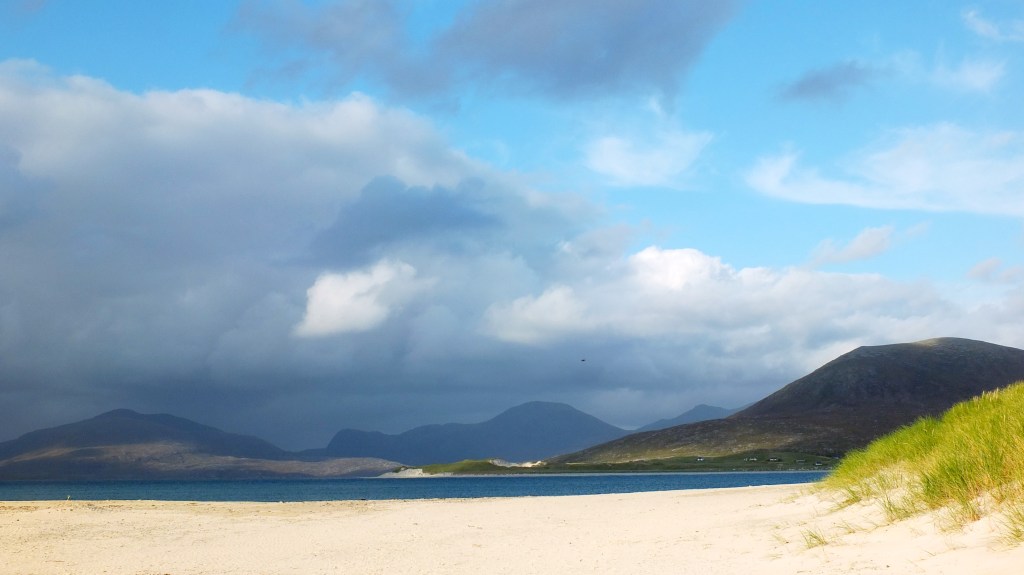
Chocolate persuaded my melancholic musings to return to the very present feeling of being cold. Flickering moments we may be, but those moments can make themselves felt sharply in fingers and feet stiff with cold in a body sat too long on sand as soft and unforgivingly cold as snow.
Chocolate solved many of our problems on this cycle ride. Too tired? Have some chocolate. Too cold to sleep? Have some chocolate. Too reluctant emerge from the sleeping bag? Have some chocolate. Too hungry? Have some calorie-dense chocolate. Too thirsty? Have some chocolate to make the water taste better. Need tea? Have a hot chocolate. Our bags were substantially lighter by the end of the ride.
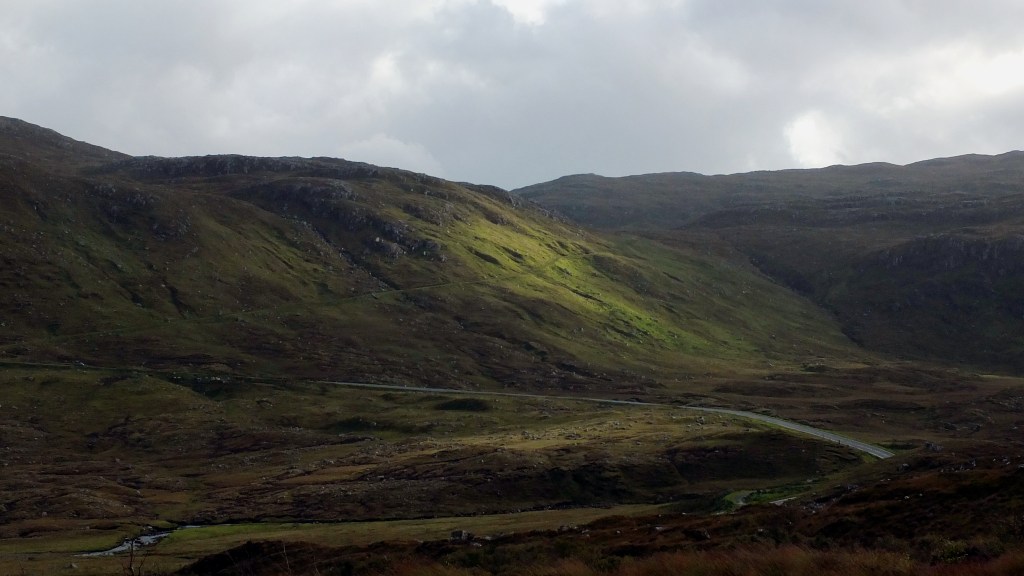
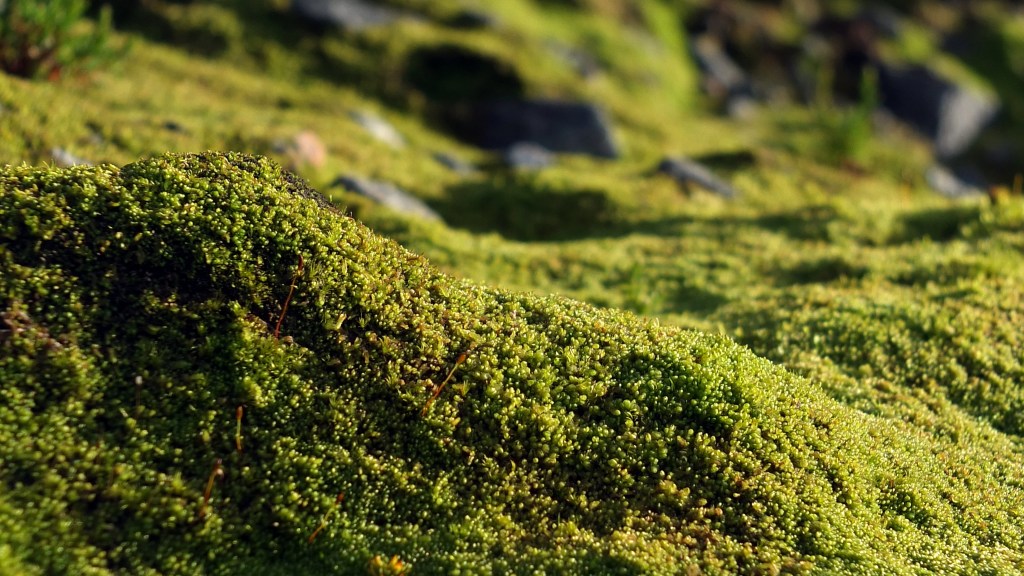
Our journey beyond Harris took us to the plains of Lewis where any sign of an endless sea was swamped by endless peatland. Brown, sludgy, damp, squishy peatland. Peatland breaks up the sky on Lewis, not the sea. Low-hung clouds break up the peatland. And two little cyclists broke up the cloud, getting very soggy for our efforts.
Rather happily though, ancient peoples left some standing stone monuments to break up the horizon as well.
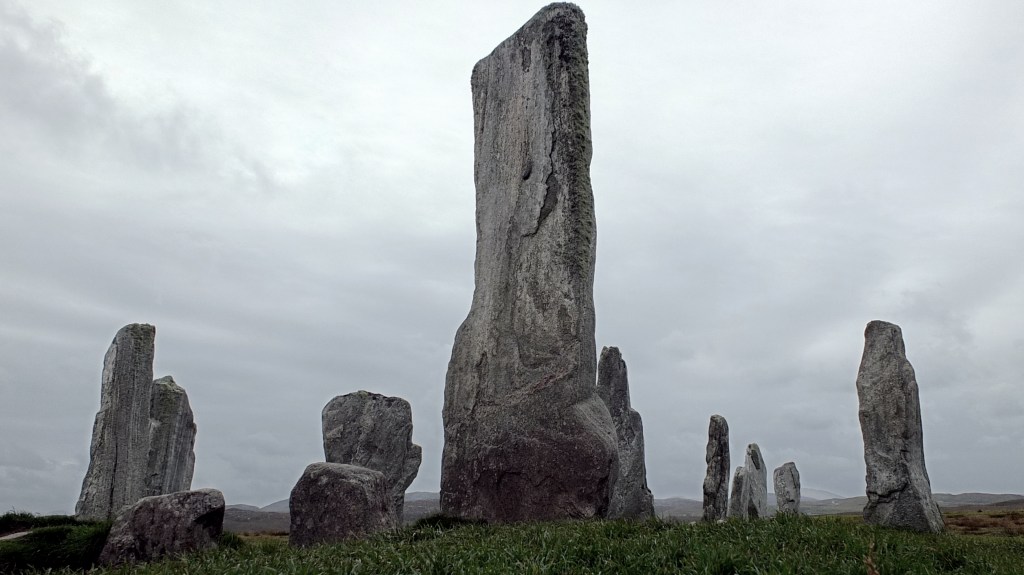
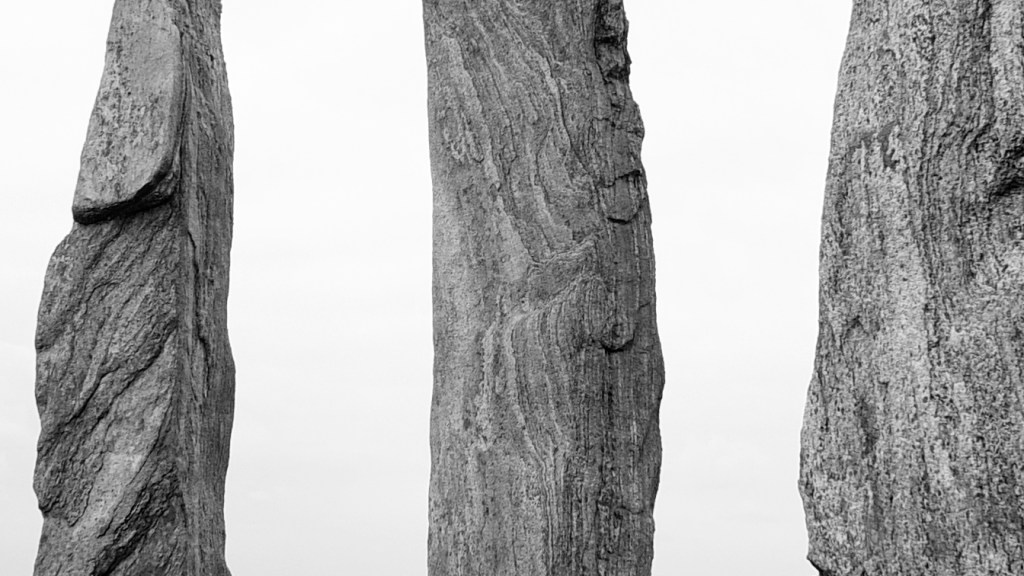
After reading about Martin Martin and the faulty description of the Callanish Standing Stones, I was very keen to see them for myself. The little book told me that these stones were once people who were frozen in alignment for misdemeanours deep in a mythological past. Some of the stones did indeed seem to stand with hunched shoulders reminiscent of grumpy huddled people. The archaeological-eye-view of these stones can rather sniffily point out the oldest stones were probably placed there around five thousand years ago after having been hefted from local Lewisian gneiss stone. What the archaeological-eye-view will also tell you though is that these stones did not begin as they look now. The stones stood alone for several centuries before a burial chamber was built, then emptied, then restored, before the entire site was left to a rising tide of peat after around two thousand years, for around two and a half thousand years. Only in the 1800s was the one and a half meters of accumulated peat removed to expose the full depth of the site buried underneath. Take a moment there to mull on those time scales. People three thousand years ago would have looked at those stones, already a thousand years old, and decided to embed themselves in it still. That would be like finding people three thousand years in the future still using the remaining ruins of one of our buildings, only to be found in another few thousand years by different people who, knowing nothing of us, weave their own myths and legends around the stones left behind. These are material remains that connect us strangers cascading through generations of thought. The people who first hefted those stones from the ground and dropped them standing upright created ripples of time that we visitors to the site are still rocking by. Now isn’t that a mighty flicker of a moment to behold!
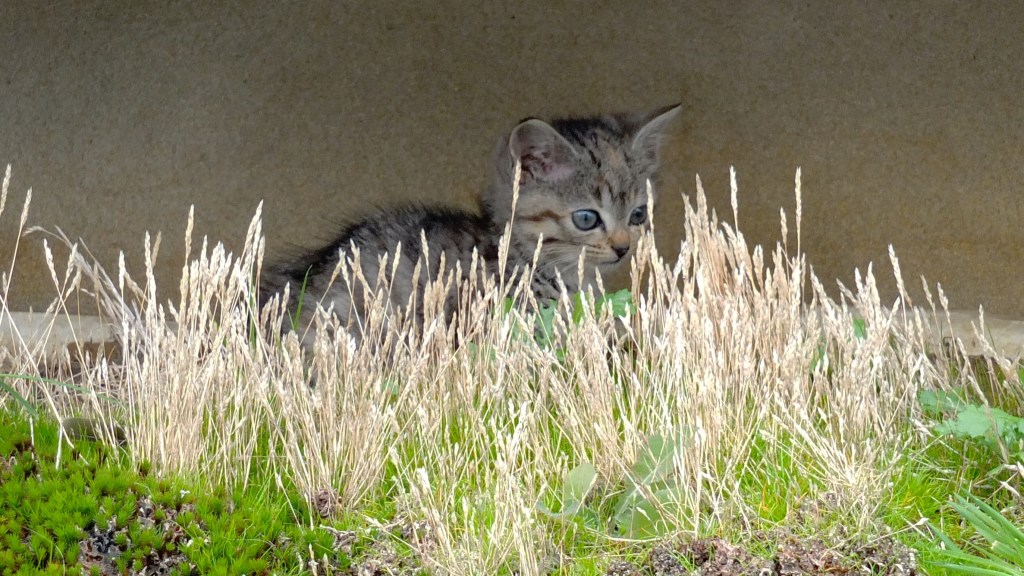
While walking back from the stones, my thoughts and feets still wandering ancient lands, a persistent mewling reached my ears from somewhere up. Of all the most adorable things, a kitten was up in the rafters of the museum! Its tabby fur would have been perfectly hidden among the grass growing up there if it weren’t for its big, marble blue eyes and tiny hungry call. I, and everyone else, were hopelessly enamoured. All intellectual curiosity of the site was forgotten. Profound as archaeology is, the stones don’t cutely mewl.
Cats further thwarted our attempts at efficient, serious, grown-up cycle touring the next day. A campsite cat found our laps to be a far superior spot to sit than the soggy ground. How could we resist the honour when the alternative meant packing up the tent and cycling into damp, damp cloud? The look of dejection bestowed on us as we eventually left was quite piercing. So began our last proper day of cycling up the Hebrides. Our original plan was to head all the way up to the top of the island, just beyond the Port of Ness. The weather was so very dreary that we decided the tick-box exercise was not worth the sapping enjoyment of cycling an extra twenty miles in the rain. We instead headed straight for Stornoway where our ferry back to the mainland was leaving the next day.
Stornoway was a shock after the isolation of the previous islands. Traffic hurtled past us and queued up in front of us. There were roundabouts and potholes and pedestrians. It felt horribly like being clobbered by a migraine of urbanism after such a dreamy journey in the wilderness. But Stornoway also held within it the best-tasting cup of tea I think I have ever had the pleasure to clutch between my hands. Sea buckthorn cream Rooibos tea. The smell of it is earthy and fresh, soothing and enlightening, nourishing to heart and soul. Like oats. Oats fuel most of my thought and movement. A day without oats has not yet been a day. And in a little tea shop in Stornoway, I finally found the oats of the tea world. A tiny bag now resides in my kitchen cupboard, wafting heady tea odours into my face every time I peer inside.
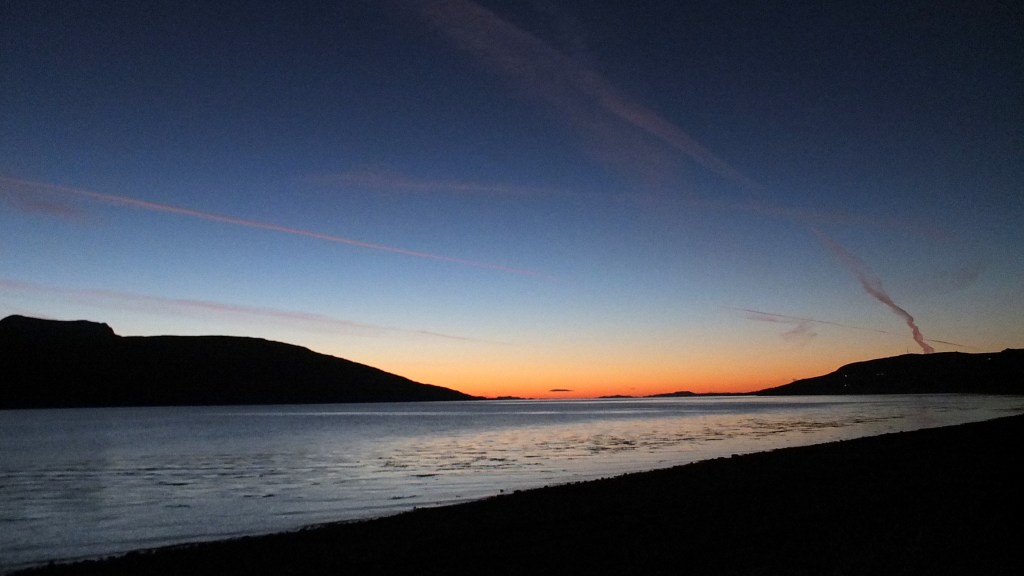
We now reach the end of the tales and travails of the Outer Hebrides. I could end with an almighty rant about transporting bicycles by train, about being forced to haul our loaded bikes up and over a footbridge at the last moment because of misleading platform signs, about slotting and balancing our bikes together in tiny designated cycle areas on carriages, about the impossibility of travelling with a bike and panniers in already over-crowded trains. These things did end our journey, but will absolutely not end this post.
I shall end instead with a promise to adventure by cycle again soon. The freedom of living with your life on your bike, and a friend by your side, is truly wonderful. We travelled by the fuel of chocolate across the islands of the Outer Hebrides, beholden to no one but ourselves, saw sights unseen by us before, drank in the views and breathed in the colours. More tales will follow. Perhaps on the other side of winter.

 ArchaeoCyclist
Beautifully written and a delight to read. I loved the photography too. I really want to go there now! Thanks for inspiring me.
LikeLike